
Many GovTech startups do not fail at the demo stage. They stall afterward, somewhere between a challenge owner’s enthusiasm and a signed contract. This article sets out three shifts that help startups in GovTech programs move from a solution to a published government challenge to real adoption.
By Tarek Salah, CEO, Global Innovation & Entrepreneurship (GIE) · 7-minute read
GovTech challenge programs usually invite capable startups to develop solutions to problems identified by government entities in the form of Challenge statements. The process typically involves co-creation with government challenge owners, who help startup teams better understand the challenge and refine their proposed solutions. Yet developing a promising solution is only part of the journey. The real test is whether the startup can navigate the entity’s chain of decision-making process, technical, regulatory, and procurement requirements to secure a pilot and, ultimately, a full adoption.
Every government innovation program has a moment that feels like victory. A startup presents its prototype, the challenge owner leans forward, and the room agrees the solution could work. In our experience, months later the same solution is often still a prototype.
The reason is not necessarily the technology. Inside any government entity, a challenge owner’s interest is the start of a process, not the end of one. Before a solution can be piloted, let alone adopted, it has to pass IT and cybersecurity review, data-sharing approval, legal checks, procurement and budget allocation. Each of these has its own decision maker, its own criteria and its own reasons to say not yet.
A simple question exposes the problem. When we ask cohorts of GovTech startups whether they know the name of the person who approves the budget for their solution, most cannot say yes. That gap, between a promising demo and the people who decide whether it is adopted, is where good solutions go quiet.
The timing makes closing this gap particularly relevant. Some governments are setting explicit targets for AI adoption and for cutting bureaucracy and holding leaders accountable for them. In April 2026, for example, the UAE announced that half of government sectors, services and operations will shift to agentic AI within two years (UAE Government Media Office, 2026), alongside its Zero Government Bureaucracy Program. Targets like these create real demand for solutions that remove work rather than add it. Startups that understand how government adopts are well placed to meet that demand. Those that do not will keep producing impressive demos.
Startups tend to treat the challenge owner as the buyer. In practice, the challenge owner is the first link in a chain of approvals. Three reviews often run in parallel: the service owner checks fit with the process and the law, IT and cybersecurity check hosting, integration and security, and data and legal check classification, sharing and intellectual property. Procurement and finance then need a budget line and a purchasing route, a leadership sponsor needs strategic fit, and frontline staff decide whether the solution is actually used.
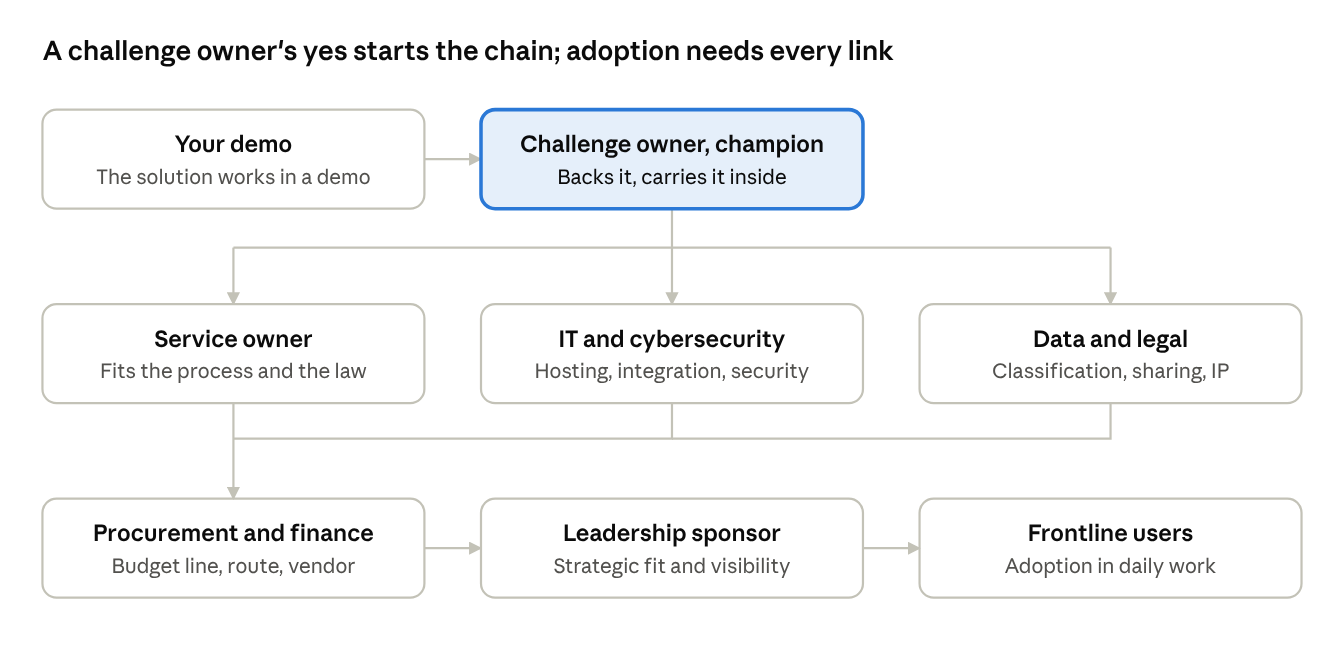
These are roles, not necessarily separate departments, and the order could vary by entity. The point is that any one of them can stop a solution, and many startups can only name the first.
The second part of this shift is attitude. These reviews are easy to dismiss as bureaucracy, but they are protections: for public money, for auditability, for the entity’s legal mandate, for fair treatment of suppliers, for citizen data and national security, and for the continuity of public services. The official who approves a solution is personally accountable for it. A startup that designs within these controls from day one, and then shows which steps can safely be removed, becomes a partner. A startup that treats them as obstacles becomes a risk.
There is also a useful test here. Does your solution remove work, or does it move the same steps onto a faster screen? Moving a long service journey online is not the same as removing steps, documents and visits from it while keeping the required human checks. Only the second contributes to a government’s simplification agenda.
Almost every adopted solution has an internal champion: the challenge owner who carries it through the chain when the startup is not in the room. The startup’s job is to make that person’s work easy and safe. That will happen only when this champion is able to build a credible internal case for adopting the solution.
Find the real need. A challenge statement is a summary. Behind it sit the entity’s strategy, the department’s KPIs and service targets, and what the champion is professionally measured on. Startups should separate what they know from what they assume about the real workflow, its exceptions, the current baseline and the users affected.
Sell the outcome, not the mechanism. “We use AI to process applications” describes a technology. “We reduce incomplete submissions and repeat visits while keeping the required checks” describes an outcome the entity can test against its own KPIs. The strongest value statements climb three steps: a measurable change, the entity KPI it moves, and the national mandate that KPI supports. Skip a step and the claim sounds like marketing.
Make AI safe to approve. An official who approves an AI agent is accountable for what it does. Be explicit about what the AI decides alone, what it recommends for a human to approve, and what stays with people only. Then show the safeguards the champion will be asked about: human oversight, audit trails, explainable outputs, a manual fallback, data hosting and processing arrangements that meet the entity’s requirements, and clear terms on whether government data is used for training. Published national and city AI ethics frameworks offer useful self-assessments, although each entity’s own requirements are what bind.
Give the champion something to forward. The startup will not be in most of the meetings that decide its future. A one-page brief, written in the entity’s language and covering the problem, outcome, safeguards, what is live today and the specific request, does that work for it. If the champion has to rewrite it, it may never be forwarded.
Many promising solutions are never rejected. Instead, they stall in an endless pilot state: a test that works, but ends without a decision, a budget or a route to purchase. Practitioners describe the same pattern: when a pilot ends and funding or procurement rules stay unchanged, momentum is lost (Choudhury, 2026). Without clear success measures, organizations also struggle to make sound go/no-go decisions on scaling (Schoop, Holden & Eggers, 2018).
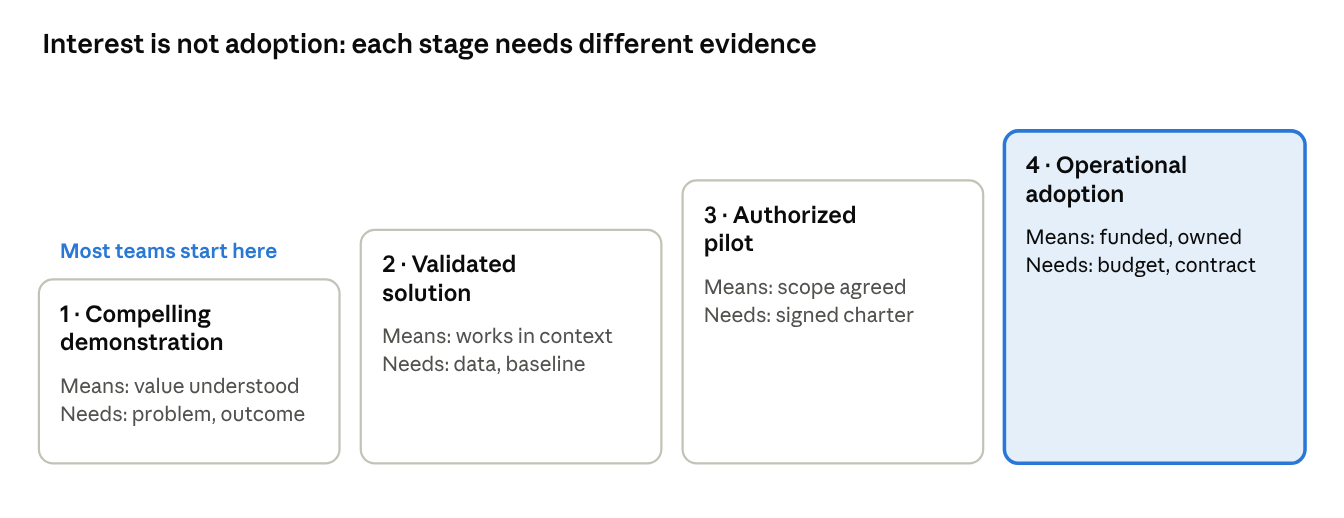
It helps to separate four stages that are often blurred together. A compelling demonstration means the entity understands the value. A validated solution has evidence that it works in the real context. An authorized pilot has agreed scope, access, permissions and success criteria. Operational adoption has funding, procurement, integration, support and an owner. Each stage needs different approvers and different evidence. In our experience, most startups coming out of a GovTech challenge program are at the first stage, and that is fine, as long as they know it.
The following table illustrates these 4 stages:
| Stage | Meaning | Evidence or decision needed |
|---|---|---|
| A Compelling Demonstration | The proposed solution illustrates how the challenge can be solved | A shared understanding of the proposed value. |
| A Validated Solution | Evidence indicates that the solution works under defined conditions relevant to the intended context. | Technical results, user feedback, or other appropriate validation evidence. |
| An Authorized Pilot | The entity permits a bounded test under agreed conditions and scope | Approved scope, access, permissions, responsibilities, and success criteria. |
| Operational Adoption | The solution becomes part of an ongoing government service or process. | Appropriate funding, procurement arrangements, integration, operational ownership, and support. |
Four practices move a startup through these stages:
Agree on the decision before the pilot starts. A pilot charter should set out scope, users, duration, environment (synthetic or anonymized data first), the data required and its classification, security review steps, roles on both sides, written success criteria and a decision date. Then ask the question most startups avoid: if the criteria are met, which procurement route, which budget line and which budget cycle will follow? A pilot without a decision date tends to become another pilot.
Be commercially ready. When the entity is ready to enter into a commercial agreement, the startup must already have in place a valid trade license, supplier registration on the relevant government procurement platforms (national, regional or entity-level), security and data documentation, clear IP and data ownership under the program’s terms, and local support capacity.
Make a specific request. “We need your support” is polite and easy to postpone. “We would like a workflow-validation meeting with the service owner and a technical representative before [date] to confirm these three assumptions” names who, what for, what evidence and by when. It is far easier to say yes to.
Stay open to alternative adoption paths. Direct contracting is not the only route to government adoption. A solution can also reach an entity through a supplier it already trusts, as a subcontractor or technology partner. Where procurement rules, scale requirements or eligibility criteria make direct contracting impractical, startups can partner with the businesses that deliver the entity’s services, such as integrators, operators or service providers. These routes come with trade-offs: thinner margins, less control over the relationship with the entity, and the need to protect IP and data terms in every partner agreement. They also need to be transparent to the entity and fully within its procurement rules.
These shifts are not only for startups. They change how hackathons and acceleration programs should be designed if adoption, rather than demos, is the measure of success.
Challenge programs and hackathons are very good at producing ideas and demos. On their own, they are much less good at producing adopted solutions. The gap between the two is not talent or technology. It is the chain of people, controls and decisions that sits between a demonstration and a contract.
Startups that map that chain, make their champion look good and feel safe, design pilots that end in a decision, and stay open to more than one route to adoption give their solutions a real chance of reaching citizens. Programs that build those practices turn government challenges from one-off events into engines of public-sector innovation.
Global Innovation & Entrepreneurship (GIE) Company is a leading open innovation consultancy, headquartered in Dubai, with offices in Egypt and KSA that’s dedicated to building sustainable innovation ecosystems, empowering innovators, and supporting scalable deep-tech startups. GIE fosters collaboration between governments, academia, industry, and NGOs to drive impactful and scalable solutions to regional and global challenges. Through strategic consulting, startup incubation, talent development programs, and large-scale innovation initiatives, GIE positions itself as the go-to partner for open innovation, technology commercialization, and ecosystem development in the MENA region and beyond, especially in Deep Tech. To discuss GovTech adoption programs, contact info@gie.ae.