
GIE PERSPECTIVES · INNOVATION MANAGEMENT
Securing an applied research budget is an achievement. Deciding where it should go requires a different discipline: connecting institutional strengths with credible demand and a feasible route to impact.
National strategies across the Gulf States have elevated research to a position of economic importance, new funding instruments have been established, and institutional leaders are increasingly required to demonstrate measurable economic and societal return on research investment. Accordingly, universities and research institutions are receiving dedicated applied research budgets to achieve these objectives.
The budget, however, arrives without a map.
A committee is convened. Around the table sit a provost, several deans, a research director and, frequently, a representative of the finance office. One dean presents the case for artificial intelligence, citing the national strategy and the institution’s published positioning. A second presents the case for sustainability on comparable grounds. A third observes that existing laboratory equipment is substantially under-used. A fourth recalls an expression of interest received from an industrial organization some months earlier.
A decision follows. It is rarely an unreasonable decision. Each participant has argued in good faith from the portion of the institutional picture visible to them. The difficulty is that no part of the meeting was designed to assemble those portions into a whole, and that nobody present holds the external evidence against which any of it should be tested.
The consequences are not immediately visible. A budget allocated in this manner produces activity, publications and equipment. What it frequently fails to produce is external funding, industrial partnership or adoption — and by the time that becomes apparent, two or three years of the institution’s research capacity have been committed.
Three substitutions recur often enough to be worth naming.
Strategic relevance is substituted for demand. A national strategy that names a field is a meaningful signal, but a policy document is not a client. It establishes that a government considers the area important. It does not establish that a specific organization holds a problem it will commission work to solve, nor that it will provide the data and site access required to solve it.
A relationship is substituted for access. A board member who also serves on the board of a major operator appears, on paper, to constitute a route into that organization. Occasionally this is the case. More often the individual holds no authority over research partnerships, or holds it and is not prepared to expend institutional capital on one. Affiliation, access and willingness to act are three distinct conditions, and only the third makes a relationship actionable.
Reputation is substituted for capability. Consider an illustrative case. The institutional website describes a laboratory as a center of excellence. The research director is aware that two of the three researchers responsible for that standing are departing, and that the remaining equipment requires a technical operator for whom no budget provision exists. Both statements are accurate. Only one of them constitutes a sound basis for investment.
A policy document is not a client. A board seat is not an agreement. A published profile is not a laboratory.
The OECD’s Frascati Manual defines applied research as original investigation undertaken to acquire new knowledge, directed primarily towards a specific practical aim. Novelty and uncertainty remain part of the definition, and applied research is still assessed by peers. What changes, for an institution allocating a budget towards application and impact, is the additional evidence the allocation decision requires.
It is no longer sufficient to establish that the work would be of high quality. The institution must also form a view on whether a specific problem owner exists, whether it can credibly reach that organization, and whether a route exists from a research result to adoption in an operational setting. The evidence required should be proportionate to the opportunity’s maturity: an emerging proposition may justify a small validation investment, while a larger commitment requires stronger evidence of demand, access and execution readiness. Each of these can be examined before substantial commitments are made, and often is not.
“Which technologies should we invest in?” is the question many institutions put to themselves, and it reliably produces a list: artificial intelligence, robotics, advanced materials, and whichever fields are presently prominent. The list is not inaccurate. It is simply not a decision, because every item on it would be defensible and none of it is specific to the institution that produced it.
A more productive formulation is this:
Where can this institution create distinctive value, for whom, and through which research and delivery partnerships?
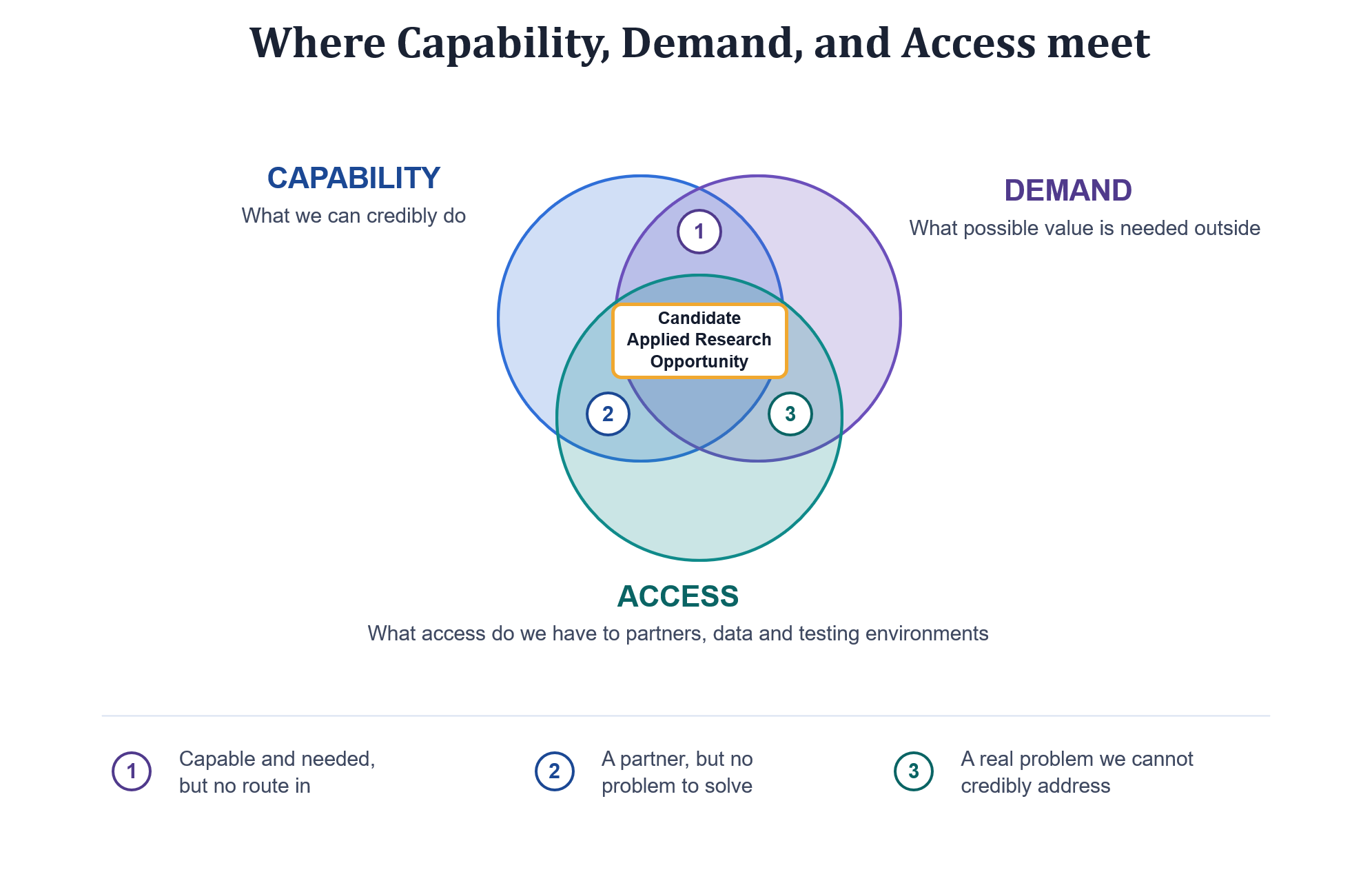
The difference is not rhetorical. Consider artificial intelligence in education. As a research theme it is broad enough to accommodate almost any proposal, which is precisely why it survives committee discussion so easily. It becomes a credible applied-research opportunity only when the institution can name a specific learning problem, the research question that problem raises, the faculty expertise available to address it, an education partner willing to participate, access to suitable data, and a feasible route to a pilot.
The theme survives that transition in name only. What emerges on the other side is an investable proposition, and it can be compared against other investable propositions. A theme cannot.
Moving an institution from a list of themes to a portfolio of propositions is a process rather than an insight, and it benefits from structure.
GIE RISE™ — Research, Intelligence, Strategy, Execution — is a methodology developed by Global Innovation & Entrepreneurship for exactly this purpose: converting an applied research budget into a defensible investment portfolio. It runs over approximately one month, depending on scope and participant availability, and proceeds through six stages. Each stage is supported by a dedicated instrument, and no stage advances until its instrument holds enough evidence to support the next decision, with the remaining uncertainty recorded rather than resolved.
| Stage | Instrument | What it establishes |
|---|---|---|
| SCAN | Future Technology and Demand Radar | What external demand genuinely exists across industry, municipal and national priorities, with every signal dated and attributed to a source. |
| ASSESS | Research Capability Heatmap | What the institution can credibly deliver, evidenced to the standard an external funder or industrial partner would require. |
| MAP | Strategic Relationship Capital Map | What institutional relationships actually unlock, distinguishing affiliation from access, and access from willingness to act. |
| ALIGN | Applied Research Opportunity Canvas | Where capability, demand and access genuinely overlap, expressed as specific and testable investment propositions. |
| PRIORITIZE | Investment Prioritization Scorecard | Which propositions merit investment, assessed against weighted criteria and five qualifying conditions. |
| INVEST | Portfolio and Commitment Board | The committed portfolio, with named owners, investment envelopes, first milestones and review dates. |
The sequence begins outside the institution deliberately. Establishing external demand before internal capability is examined prevents existing strengths from framing the question, which is the mechanism by which an institution arrives at the conclusion it already held. Capability is then assessed against demand that has been documented independently of it.
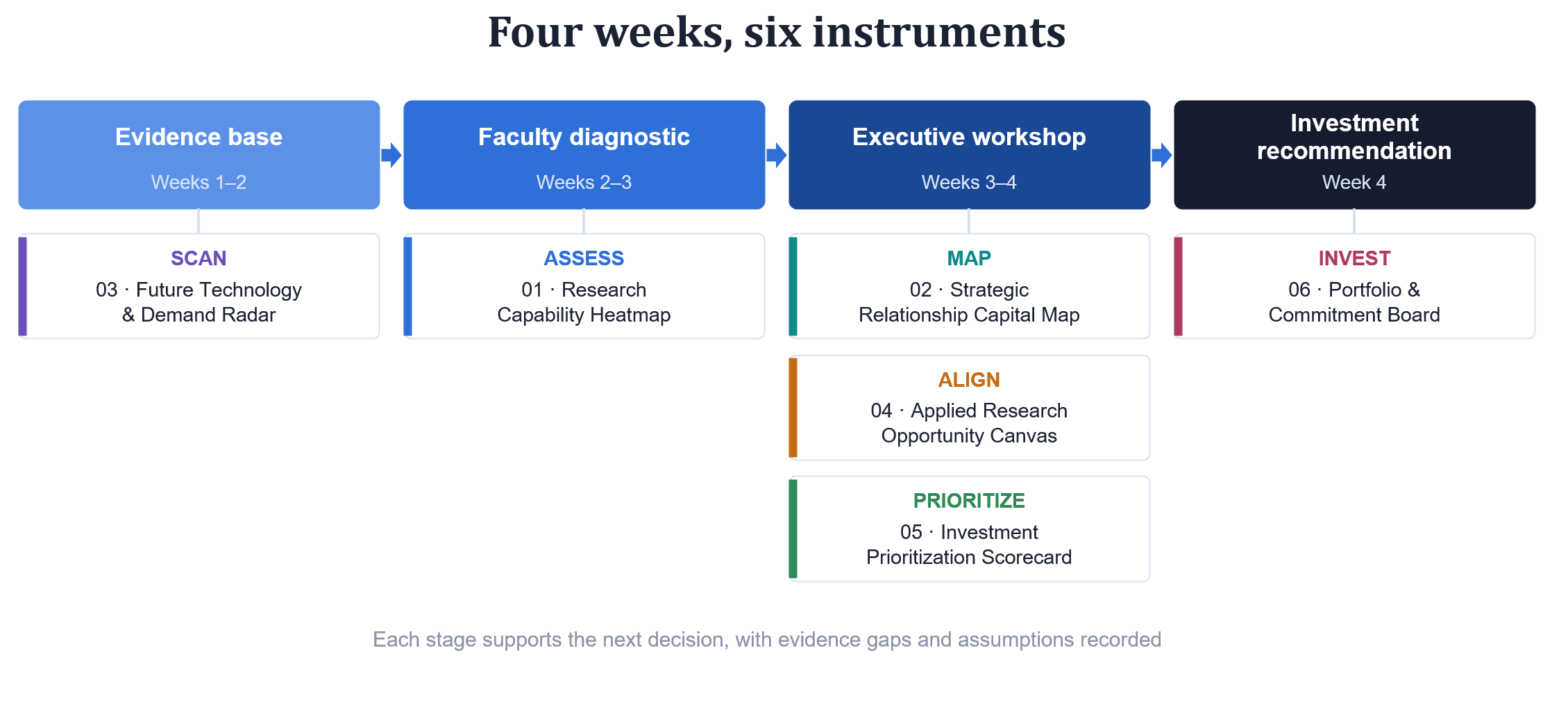
Across the four weeks, each external source is assessed for authority and each claim classified; internal and external evidence are reconciled, with points of disagreement recorded rather than resolved prematurely; and the resulting portfolio is put to leadership for approval.
Each investment proposition is scored against six weighted criteria: institutional capability; alignment with national and city strategy; industry and market demand; ecosystem advantage; funding potential; and impact and commercialization potential.
Five qualifying conditions apply in addition, and all five must hold. There must be a genuine problem with demand that can be named. There must be a plausible partner, testbed or pilot route. There must be a team both willing and able to lead the work. There must be an execution pathway capable of withstanding external scrutiny. And there must be a genuine research question: new knowledge to be generated, or a scientific or technical uncertainty to be resolved. Without that last condition, a proposition may describe a sound consultancy assignment rather than a research investment.
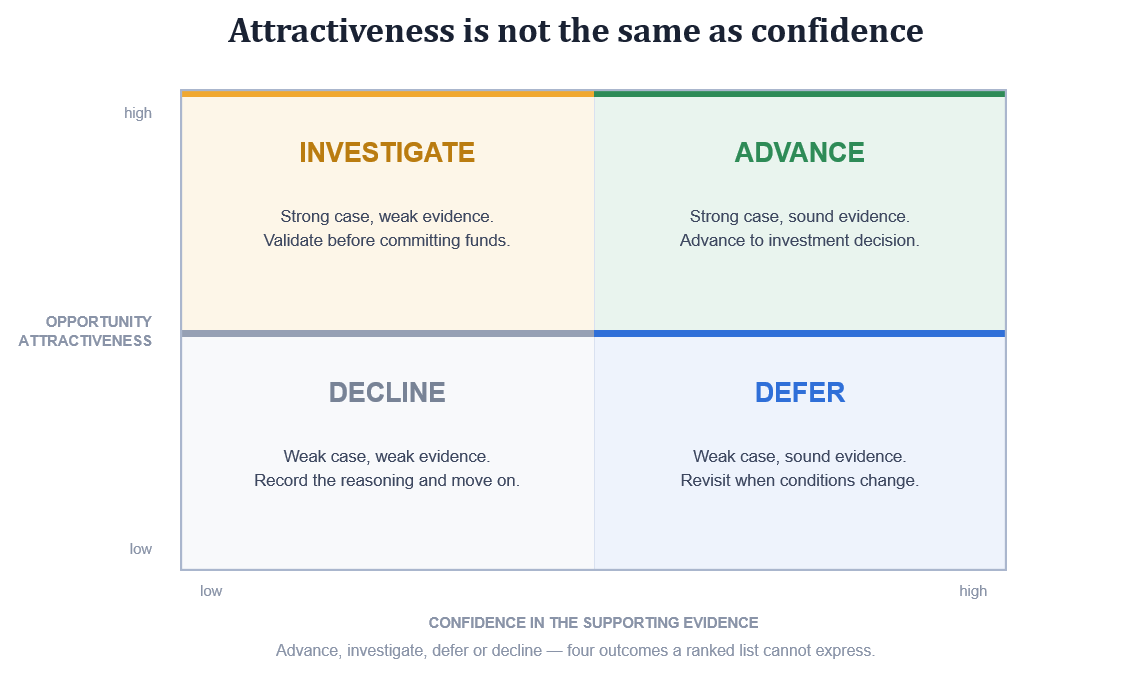
The assessment further separates an opportunity’s attractiveness from the institution’s confidence in the evidence supporting it. A proposition that scores well but rests on substantial unanswered questions may warrant further validation rather than immediate commitment. This distinction allows leadership to determine what to advance, what to investigate, and what to defer — three decisions that a simple ranked list cannot express.
An institution may decline a sound opportunity because no funding call is presently open for it, and commit to a weaker one because a call happens to be available.
Funding calls open and close on cycles measured in months. Research capability is constructed over years. Within RISE, funding potential is therefore treated as one weighted criterion among six rather than as a qualifying gate. An open external funding call is not a prerequisite for prioritization; any investment commitment must nevertheless carry a credible resourcing pathway. The alternative is a research portfolio determined entirely by the application deadlines of other organizations.
Every claim admitted to the decision is classified as evidence, judgment or assumption, and every source is assigned a tier according to its authority. The classification is completed before the workshop convenes.
The discussion then shifts from which participant holds which conviction towards what the institution demonstrably knows. Expert judgment remains essential. The method makes its basis and its remaining uncertainties explicit, so that experience and documented evidence can be weighed together rather than confused with one another. Early scrutiny exposes weaknesses while they remain inexpensive to address.
Expert judgment is essential. What the method adds is a record of what that judgment rests on, and of what remains unknown.
The value of the method lies less in any single instrument than in what it makes possible: a shared structure within which researchers, institutional leaders and ecosystem partners can examine choices that would otherwise remain distributed across departments, and reach a decision that can be explained to a board, a ministry or a funder.
REQUEST A BRIEFING SESSION
Before you allocate, can you name the evidence behind each domain you are about to fund?
If the answer is not a confident yes, that is what GIE RISE™ is for.
Write to hussien.mostafa@gie.ae to reserve a 30-min briefing.
Global Innovation & Entrepreneurship (GIE) Company is a leading open innovation consultancy, headquartered in Dubai, with offices in Egypt and KSA that’s dedicated to building sustainable innovation ecosystems, empowering innovators, and supporting scalable deep-tech startups. GIE fosters collaboration between governments, academia, industry, and NGOs to drive impactful and scalable solutions to regional and global challenges. Through strategic consulting, startup incubation, talent development programs, and large-scale innovation initiatives, GIE positions itself as the go-to partner for open innovation, technology commercialization, and ecosystem development in the MENA region and beyond, especially in Deep Tech.